
How to Put Self-Understanding into Everyday Practice
Use self-understanding in everyday decisions: consider your circumstances, explore responses and learn from a small action, with a relationship example.
To put self-understanding into everyday practice, consider both your familiar patterns and the circumstances, explore a few possible responses, and choose a small action if one feels useful. When someone asks you to take something on, that means looking beyond a label about yourself to the decision in front of you. What happens next can give you something more specific to learn from.
Put self-understanding into everyday practice
Imagine Sam’s partner asks, “Could you organise lunch for the family on Sunday?” Sam enjoys bringing people together and is often described as the organised one. Saying yes would feel familiar.
This week, though, Sam has a work deadline on Friday and has set Saturday aside to rest. The wish to help is genuine; so is the limit on time.
“Be less of a people-pleaser” is a broad judgement. “Decide what I can offer for Sunday without giving up Saturday” is a situation Sam can work with. It leaves room for generosity, rest and a conversation about sharing the work.
Treat a profile as a starting point, not an instruction
You might recognise something of yourself in a profile: enjoying responsibility, valuing connection or liking a plan. Ask where the description fits this situation and what it leaves out.
Personality patterns can be informative without describing every moment. In a synthesis of 15 experience-sampling studies, Big Five questionnaire scores predicted people’s average self-reported behaviour, while their reports also varied considerably from occasion to occasion (Fleeson & Gallagher, 2009). That finding concerns the Big Five; it doesn’t validate every profile or tell someone what they should do in a particular conversation.
Being “the organised one” doesn’t make every organising task Sam’s responsibility. Nor does declining a task erase the care Sam feels for the family.
Try turning a label into a question:
Instead of “I’m helpful, so I should say yes”, ask “What would a workable offer of help look like this week?”
Include the circumstances before choosing a response
What time, resources, responsibilities or support are actually available? What has the other person asked for, and what are you assuming?
Sam knows about the deadline and the planned rest day. Sam doesn’t yet know whether “organise lunch” means choosing a restaurant, cooking for everyone or coordinating a shared meal. Asking about that is part of understanding the situation.
The COM-B model of behaviour considers capability and opportunity alongside motivation: what someone can do, what their environment makes possible and what moves them to act (Michie et al., 2011). For Sam, wanting to help is one consideration; the time available and how the work is shared also deserve attention.
A question to try is:
“What would need to be different for this to be workable?”
The answer might be a smaller task, more time or someone else taking responsibility for part of it. You can consider asking for those changes rather than treating limited capacity as a personal failing.
Explore more than “yes” or “no”
Before settling on a response, consider a few possibilities and their trade-offs. Sam could:
- Offer a defined part: “I can book a table, but I can’t organise a meal at home.” This offers help while limiting the task, although a restaurant may not suit everyone’s budget.
- Propose shared responsibility: “I’d like to come. Could you arrange the food and invitations? I can bring dessert.” This depends on a clear agreement rather than assuming the work will be shared.
- Suggest another date: “Could we host next weekend instead?” This keeps hosting as an option, if the date is flexible.
- Decline organising this time: “I can’t take on the arrangements this week.” This leaves the partner to decide whether and how to proceed.
There is no personality-correct answer. Which option fits Sam’s priorities and the actual situation—not which proves Sam is generous or assertive?
The partner’s preferences matter too. Sam can ask about them without guessing from a profile or deciding what the partner must need.
Try one response you can stand behind
Sam chooses a specific offer:
“I’d like to see everyone on Sunday. I can bring dessert, but I can’t arrange the lunch this week. Would you be willing to organise the food and invitations?”
The action is to make an offer and ask a question. Getting agreement is outside Sam’s control.
If finding the words is difficult, you could say your chosen sentence aloud first or write it down. Adjust it until it sounds like something you would actually say. You don’t need to rehearse an entire conversation or predict every reply.
Choose a situation where you have enough safety and freedom to make a choice. If saying no could bring intimidation or retaliation, prioritise safety and appropriate support rather than testing a new response. Unfair expectations don’t become your personal-development task simply because you’ve noticed them.
Let the experience change your understanding
Suppose the partner agrees, then asks Sam to choose the menu and place the food order. They may not have agreed on what “organise the food” included; who will do what still needs clarifying.
Sam could say: “I meant that I can bring dessert, but I can’t choose or order the rest. Can you take that on?” Alternatively, they might agree on a different plan.
Afterwards, Sam has something more specific to consider than “I need better boundaries”:
- What happened? The partner agreed to organise, but some decisions came back to Sam.
- What remains uncertain? Whether the partner understood the offer in the same way.
- What might be worth trying next? Naming who will choose, order and invite, rather than relying on the word “organise”.
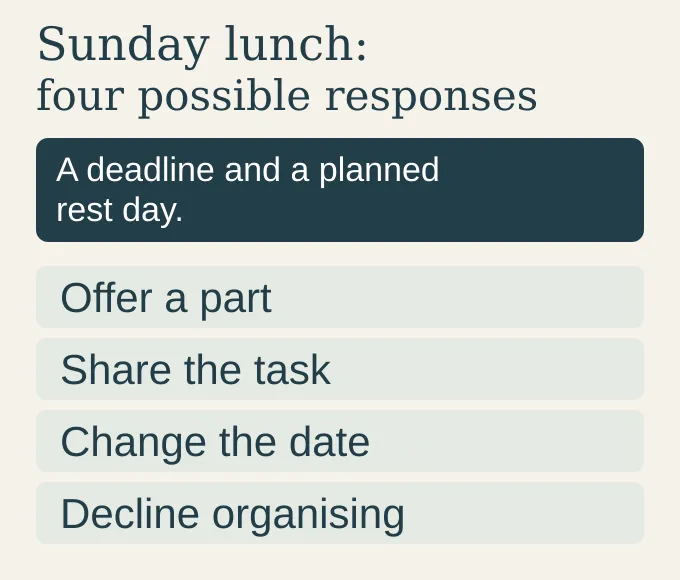
One exchange doesn’t establish either person’s intentions or a fixed relationship pattern. You can keep a response, adapt it or decide that no further action is needed. The decision map below brings Sam’s choices and learning together.
One person, several possible responses
- Situation: Sunday lunch to organise; a deadline and a planned rest day.
- Options: Offer a part · Share the task · Change the date · Decline organising.
- Try: Sam offers dessert and asks the partner to organise lunch.
- Learn: Some decisions return. Clarify who chooses, orders and invites.
Bring the learning to another part of life
The same question can travel without the same answer: “What can I offer, in these circumstances?” At work, that might mean discussing which existing priority would move before accepting another task. With a friend, it might mean offering a short call rather than an evening you don’t have available.
HumanInPractice is developing a Personal Growth Intelligence platform around individuality, patterns, behaviour and context. Its direction is to help people use self-understanding in the situations they actually face, with room to explore possibilities, practise and learn.
You don’t need to become a different kind of person to consider a different response. If no action feels useful, an insight can remain a question for now.
What the research says
Fleeson and Gallagher’s (2009) synthesis combined repeated reports of behaviour across 15 studies, mostly with university students. It found both meaningful differences between people’s average behaviour and substantial variation within individuals. Because the questionnaires and momentary reports were both self-reports, shared reporting habits could influence the findings. The research didn’t test the conversation suggestions here or demonstrate that anyone can change their behaviour on demand.
Michie and colleagues (2011) developed COM-B within a framework for designing behaviour-change interventions. Their paper examined how reliably the framework could classify interventions in tobacco control and obesity; it was not a trial of personal growth or relationship conversations. It offers a way to consider conditions around behaviour, not evidence that these prompts will improve a relationship.
Together, these sources inform the attention to patterns and circumstances. The practical sequence and conversation examples are suggestions to adapt, not a tested intervention. Neither paper evaluated HumanInPractice.
References
- Fleeson, W., & Gallagher, P. (2009). The implications of Big Five standing for the distribution of trait manifestation in behavior: Fifteen experience-sampling studies and a meta-analysis. Journal of Personality and Social Psychology, 97(6), 1097–1114. doi:10.1037/a0016786.
- Michie, S., van Stralen, M. M., & West, R. (2011). The behaviour change wheel: A new method for characterising and designing behaviour change interventions. Implementation Science, 6, 42. doi:10.1186/1748-5908-6-42.