
Turn Self-Awareness Into Action at Work
Connect one self-awareness insight to a specific work moment, choose an optional cue-linked behaviour to try and review it without grading yourself.
To turn self-awareness into action at work, pick one recent moment and notice both what happened and how you responded. If you want, choose one small action to try next time; treat your insight as a possibility, not a rule.
The diagram below maps the steps; trying an action is a choice, and you can skip it, adapt it or stop.
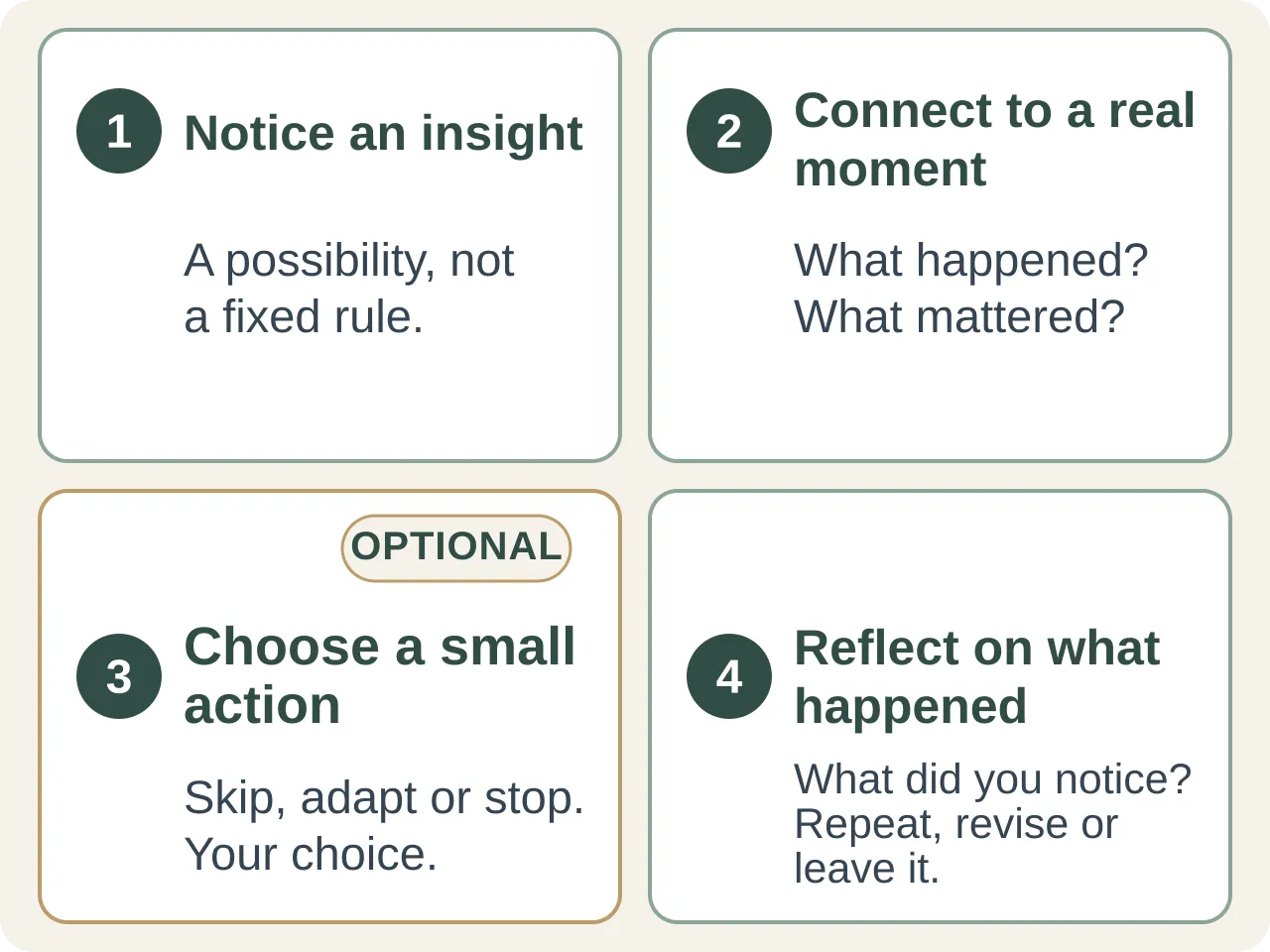
How do you turn self-awareness into action at work?
You leave a meeting still thinking about a reply. Perhaps a colleague asked for more time and you quickly explained why the deadline mattered. Start by writing down what you remember, without guessing what the other person meant.
Imagine Priya, a team lead, in that situation. Later, she wonders if reliability mattered so much to her that she responded quickly. That’s one idea to explore—not proof of a fixed trait or her colleague’s intentions.
Connect the moment to what matters to you
Try asking yourself:
- What did I see or hear?
- How did I respond, or want to respond?
- What mattered to me? What else might explain the situation?
Priya might connect her reply to her value of reliability. She can also consider that her colleague wanted time for a careful review. Both possibilities help her understand the moment without jumping to a conclusion.
A profile or assessment can offer language to reflect on, but it won’t explain every reaction or situation. See whether an insight fits this moment; it may not.
Choose one small behaviour to try
Only try an experiment if it feels useful. Choose an action you can control, then link it to a situation you’ll recognise: “If [situation] happens, I’ll try [action].”
Priya might try: “If a teammate asks for more time, I’ll ask what still needs review before I restate the deadline.” She can notice whether asking first gives her information that helps her respond. She doesn’t need to get a particular answer or prove that her approach is right.
Keep the action small and easy to adjust. A broad promise like “I’ll respond differently” may be hard to use in the moment. If the situation changes or the action doesn’t fit, she can adapt it or let it go.
Review what happened without grading yourself
Afterwards, ask: What happened? What did I notice? Would I try the same action again, change it or leave it? If you didn’t try it, you can decide whether it still matters.
One conversation can’t establish a fixed pattern or tell you what another person intended. Treat it as one experience to learn from, with its own context.
When not to force an experiment
Not every work situation needs an experiment. If no action feels useful—or you don’t want to change anything—you can leave the insight as a question. Keep any experiment within your role and workplace policy, and don’t let it delay a decision that needs timely action.
If you find yourself going round and round about a difficult exchange, a direct conversation or appropriate workplace support may be more useful than more solo reflection. Sometimes the next step is a different action, a better question—or no change for now.
What the research says
Researchers call a plan that links a situation with an action an implementation intention (Wang et al., 2021). One meta-analysis looked at a combination of two approaches: thinking about a goal and what might get in the way, then making an “if this happens, I’ll do that” plan. Across 21 studies with 15,907 participants, the combined approach had a small-to-medium average effect on reaching goals. Results differed depending on how the strategy was delivered, and the authors noted that publication bias might mean the true effect is smaller (Wang et al., 2021).
A workplace study followed a health-improvement programme across 29 hospital teams. Teams whose action plans more often used if–then wording also tended to report greater impact six months later. This was an association, not proof that the plans themselves caused the reported impact. How open the team was to new ideas and whether people expected good outcomes were also linked to perceived impact (Lehmann et al., 2019).
These studies offer some context for making an action specific, but they did not test the reflection steps in this article as a complete exercise. They don’t show that this approach will work for everyone or lead to lasting change.
References
- Wang, G., Wang, Y., & Gai, X. (2021). A meta-analysis of the effects of mental contrasting with implementation intentions on goal attainment. Frontiers in Psychology, 12, 565202. Full text.
- Lehmann, A. I., Brauchli, R., & Bauer, G. F. (2019). Goal pursuit in organizational health interventions: The role of team climate, outcome expectancy, and implementation intentions. Frontiers in Psychology, 10, 154. Full text.